Behind the pantry door
I think one reason why we buy things is that we forget about what we already have — things at the bottom of closets, in the back of pantries, high up on shelves, deep in drawers, way back in the medicine cabinet. I think you know what I'm talking about. Like when you go for an aspirin and you find a bottle that expired five or six years ago, and there's more — things you bought recently stacked right on top of it.
It has weight. It has expense. And so it raises a few questions. Think about this: do you need more closet space? Do you need a bigger pantry? Do you need to pay for a monthly storage unit at one of those giant mega-storage places? I wonder how many times people have bought something they already own, something they'd long forgotten about.
This causes problems, don't you know?
Here's what I've found — and I've written about it before. When you have many iterations of the same exact thing, all of them become less important. It's pretty easy to keep up with your car keys because you have one, maybe two sets. That's it.
Reading glasses are what made me think of this. I bought a ten-pack of reading glasses — cheap ones, from the Books-A-Million store. They're not expensive, and they came in a bunch of crazy colors, like Skittles for your face. Green, purple, red, grey. But I digress. Do you know how many I can actually find right now? One, maybe two pairs. That's because when you have five of something, none of them becomes important. Your brain doesn't need to store its location anywhere critical in your consciousness, because what do you care? If you set down the green ones and forget where they are, you'll run into the purple ones or the red ones eventually.
Tape measures, too. My God, I don't know how many I've bought. Where the hell are they? I think there's one in my junk drawer in the kitchen. I just found another one yesterday. I used to keep one in my car on the off chance I ran to Home Depot and needed to measure something. But guess what? Of all the times I've walked into Home Depot, I've almost 100% of the time forgotten to bring it in. So what do I do? I go to the tool section, grab one off the shelf, use it, and leave it somewhere in the store. Don't judge me — you do it too. Go to Home Depot and you'll see tape measures laying all over the place. Still in the package.
“But that’s the point. When we have too much of one thing, every one of them becomes less important. Not critical. Extra.”
I thought about this on a retreat in Arizona, where the private chef had everything laid out on a long table. On the left side were the ingredients she'd need for the coming days. On the right were things we could all grab as we passed through — nuts, dried berries, a couple of prepackaged things. As you walked by, you realized you had many choices: different ingredients, different ways to throw together your own snack. But it made me think, how many things are in my cabinet that I've completely forgotten about?
Things get tucked behind closed doors, way in the back. You forget about them, so you buy more.
Here's an experiment: take the things out of your pantry and put them on your countertop where you see them every single day. Watch what happens to your mindset. It shifts from I don't have anything to eat to look at all this stuff — I can make something with this. That's a mindset change.
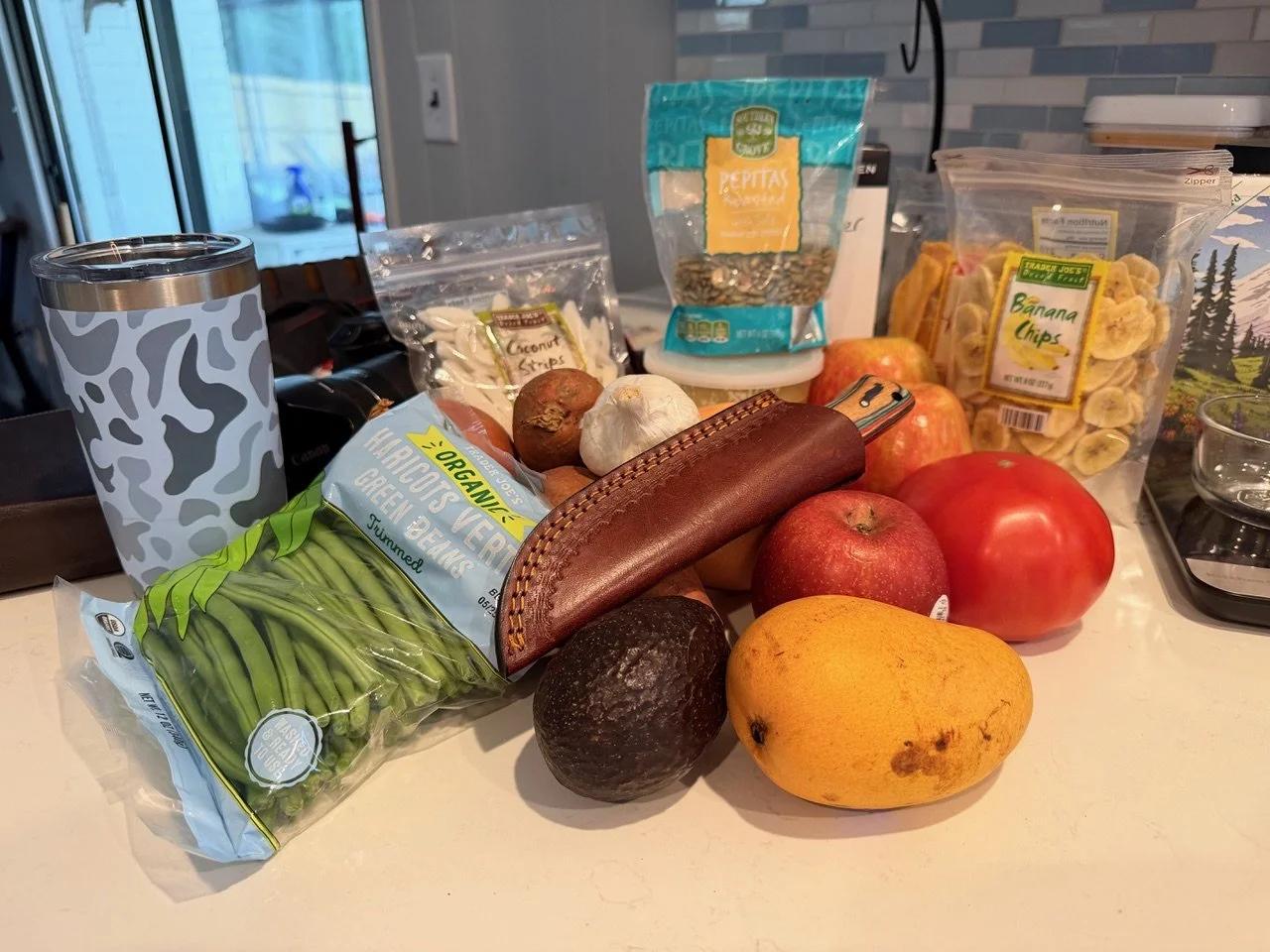
And this is a metaphor — not just for your pantry or your junk drawer, but for the things stored in the back of your mind. Unfinished tasks. Things you should have done, could have done, would have done. But didn't. These are the things sitting in the back of your consciousness as part of your aspirational self.
So here's my challenge to myself. You can follow along or not — it doesn't matter to me. Empty a drawer. Empty a closet. Empty a physical space and lay everything out. Now look at it. You can go full Marie Kondo on it, or just follow along with what I'm saying. Ask yourself: Is this item useful? Is it still relevant? Does it exist because it was once part of my aspirational self — and am I doing anything to actually get closer to that?
When you ask yourself those questions while looking at the things you own, you'll have your answer. If a book on origami is something you bought because you aspired to do origami, but you haven't touched it or even thought about it in a year, two years, five years — then you're not doing anything to get closer to that version of yourself.
I'm sorry. That book can go.
